Close my eyes and jump!

I remember jumping off the high dive when I was little.  I can remember hopping out of the van at the swimming pool and proclaiming to my sisters “Today I am going to jump off the high board!”  I have a vivid memory of running to that tall ladder during the first adult swim of the afternoon while yelling for my mom to get ready to catch me.  Along the way I made sure that my sisters and friends were looking.  As I climbed up all those steps, I was too excited to think any negative thoughts about what was to come.  The most vivid part of my memory was slowly walking out to the end of the long blue board.  With every step closer to the end, the board got bouncier and the fear became stronger.  By the time I reached the end, I was overwhelmed with anxiety about the jump in front of me and became paralyzed.  As I sit here this morning, I’m experiencing some of those same feelings.

As I’m sure you have all witnessed (and probably even experienced on your own), the next few minutes were filled with urging and reassurance from my mom and sisters (and I’m sure more than a few “HURRY UP! JUST JUMP!”s).  I can’t say for sure how the story ended that first time I wanted to jump; maybe I mustered up the courage or maybe I was conquered by fear and backed down that ladder.  What I can say for sure is that I eventually jumped, not because I was tremendously brave, but because the words of support and encouragement from my friends and family were stronger than all of my doubts.

In just a few hours we will cram my bags full of birthing kits, medical supplies, clothes, shoes, and other necessities (including several boxes of macaroni and cheese, ranch packets, a favorite blanket, a meat grinder and just a small crock pot) into the back of my sister’s van.  Once again I am certain that I have not overcome the paralyzing task because of my own bravery, but because I am surrounded with all of you cheering me on.

Thank you for all the encouraging emails, cards, texts, phone calls, and facebook messages. Thank you for both the silent and verbal prayers. Thank you for the small donations and the large ones. Thank you for showing me your love and thank you for having faith in me.  Thank you for helping me get there! (Now let’s just hope that my deodorant does, too!)

A village not so different from my own…

Overnight I became a single mother of four children- kind of. Last week my oldest sister Tracy and her husband took a much needed, five day vacation to Mexico.  While they were relaxing on the beach, I was running their 11 -year-old to softball, begging their 3-year-old to take a nap, dropping their 9-year-old off at basketball camp, catching their 6-year-old as she jumped off the diving board and toting all four of them to bible school!  Now, if you know anything about me, you know that I would never admit (especially to Tracy) that taking care of my sweet nieces and nephews was much more exhausting than I ever expected. So I won’t.

In the midst of all this running from one side of Versailles to the other, I became reacquainted with the town I grew up in and the wonderful people who still inhabit it.  At Bible School I taught alongside my past art teacher, at the swimming pool I sat with a former teammate, and at the softball games I cheered with an old coworker and friend.  Each time I got into a conversation with someone from my hometown, I became anxious thinking about how to explain why I would want to leave this place of comfort and go to the other side of the world.  I am happy to say that most of the time I was able to steer the conversation elsewhere and avoid trying to give an explanation that I didn’t fully understand myself.

After checking the last ball game off of the calendar and saying goodbye to my wonderful nieces and nephews, I settled into a peaceful (no radio, no kids asking to watch a movie, no fighting over who would sit in the front seat) drive back to my home in Kettering.  For the thousandth time I was trying to figure out why I feel so pulled to pack up and head to a country full of people that look, act, and think so different from the way I do.  But then, out of the blue, it hit me.

The people in South Sudan make a living by farming.  These people understand the importance of and place high value on education.  The villagers know what it means to work hard. They know each other by name and often introduce someone by telling who their mother, sister or uncle is.  They look out for each other and are wise enough to know that secrets don’t keep for long.  The most important word to them is community.  If those same things don’t paint a picture of Versailles, I don’t know what does.

It might still be hard to explain to someone why I’m trading my bathroom for a latrine or looking forward to cleaning my first chicken, but at least now I understand why a place thousands of miles away feels so much like home.

Who will I become?

So far, we’ve survived. Its been nine days and I know most of my students’ first names.  I’ve figured out who needs to be in the front of the classroom (because they can’t seem to remember to put on their glasses before coming to school) and who needs to have a table to themselves (because they can’t keep their hands off their neighbor).  We have come to the point where we can begin to truly learn about one another.  I have started asking questions about their goals and dreams and I have asked them to start thinking about where they are going and what they want to be.  As I ask my students those questions I remember the story my mom tells me about my response to that same question.

“What do you want to be when you grow up?” a friend of my parents asked me.  Without a second to think, I replied confidently “Just a plain mommy.” I said. “Like my own mommy.”  My four-year-old brain must not have had the capacity to understand that my mom was more than just a mommy.  By profession she is a nurse, but had taken several years off work to stay home to raise myself and my three sisters.  After the four of us were in school she returned to work as a home health nurse.  For years she spent every day driving from home to home providing loving care to those that were not able to visit a doctor or a hospital.  She was the one who sat by my uncle’s side and held his hand as he lost his battle with cancer.  She took care of her own mother for several years while she was overtaken by dementia and she eased the discomfort of her father during the time he waited to join his wife.

All three of my sisters did a better job of me than being ‘like my own mommy.’  They all followed in her footsteps and when to nursing school.  My oldest sister, Tracy, splits her time between cancer care and school nursing.  She is a brave and confident woman who is well respected by her coworkers and patients alike.  Angie, who is the next oldest, is a labor and delivery nurse.  I couldn’t imagine a person with more patience or a more calming presence than Angie. She is wonderful at easing the fear of new mothers and soothing crying babies. My youngest sister, Susan, aspires to be a Hospice nurse.  She is extremely empathetic and finds joy in bringing comfort to those who grieve the loss of a loved one.  I don’t know if they know it, but I admire them greatly.  I see the passion each of them has for what they do and the compassion they have for the people they take care of.

When I was in South Sudan I met 46 women who displayed these same characteristics.  I had the opportunity to help at a Traditional Birth Attendant class that Diantha organized with help and financial support of people from the local Martha Clinic and Mother’s Union.  (I know nothing about taking care of pregnant women or delivering babies, but let me tell you, I did one heck of a job updating the excel spreadsheet, if I do say so myself!)  As I compiled the information we had collected about these women who delivery babies in their villages, I was shocked to see that most of them had been delivering babies for more than twenty years and this was the FIRST training they had ever been to.  I don’t know about you, but I can’t imagine what it takes to step up to the plate and become a midwife with no training.  I can’t imagine the heartache of the trial-and-error it must have taken for them to figure out how to successfully deliver a baby.  My heart goes out to these women.  As I sat there and listened to the discussion I felt much like I often do when I gather for a meal with my mother and sisters.  They women talked passionately about the type of issues they encounter and offered advice and shared stories about times they had been in similar situations.  During lunch the second day, someone turned on a television in the back of the room that just so happened to be airing an African soap opera in which there was a woman giving birth.  The screaming woman caught the attention of everyone in the room and quickly chairs were turned around and eyes were glued to the scene of a woman in childbirth.  Diantha and I couldn’t help but laugh at the irony.

At the end of the second day, as a gift for completing the training, each of the women was given a certificate of completion as well as 10 birthing kits provided by the United Methodist Committee on Relief (UMCOR).  To my surprise, the birthing kits did not contain the “luxuries” we are used to having here in the states, like anesthetic or pain killers, but instead include the basic necessities for a clean birth.  Each kit contains a 1 oz bar of soap, a pair of rubber gloves, a square yard of clean plastic sheeting, a 3 inch piece of cotton string, a razor blade and two receiving blankets.  All of the contents are contained in a plastic bag to protect them from dirt.  You would not believe the women’s excitement at receiving these things.  As each woman’s name was called, she would dance down the center aisle and sing praises to God for his provision.  She would take the certificate and hold it in the air and thank God for the training he had given here.  She clutched on to the bag of birthing kits, elated to know that the next ten babies she delivered would have a sanitary place to enter the world.  I was blown away by the compassion and dedication of these women to help all the new mommies of their communities.

As I sit here reflecting on my response to that question so long ago, I can’t help but think that maybe my 4-year-old heart knew something I didn’t.  Although I have no children, I can see both as a teacher and a missionary, God has challenged me to love people unconditionally.  He has put me in a position to help provide for people’s most basic needs and He has asked me to practice being selfless.  He has guided me to be both an encourager and supporter.  As I think about it now, I am quite sure that in doing all of those things I am much like the ‘plain mommy’ I aspired to become- those are the things that make me like my own mommy.

If you are interested in learning how you can help support more health trainings like the one mentioned above, please contact Diantha Hodges at dianthah@yahoo.com

Do as I…

Today was our first day back to school.  It was filled with students rushing through the hallways looking for the right class, teachers cramming their short term memories with each student’s name (and his or her unique way of spelling it), and principals, counselors and secretaries scrambling to fix schedules, collect fees, and put out any other fires they find. And no, there was not really a fire during our very first period on our very first day of school- it was only an untimely malfunction of the fire alarm.  I’m happy to say that we all survived.

I am starting my ninth year at WCMS and am a 7th grade math teacher (go ahead and groan).  One of the many things I have learned is that twelve-year-olds are ALWAYS interesting.  During the last class of the day a few of my students were struggling to hang on.  I knew they had been through countless hours of teacher introductions, seat assignments, and paperwork so I was trying my best to quickly finish my classroom housekeeping.  To my surprise I looked up and saw one of my students taking off his shoes and setting them on top of his desk! ‘Why in the world does he think that is okay?’ I thought to myself.  I gave him a strange look and started to tell him that it wasn’t appropriate to take his shoes off in class.  My thoughts must have been clear as day because before I could even finish a student in the front row pointed down to my own feet.  Without thinking I had stepped out of my shoes (the first time in months wearing something other than flip-flops) and was standing there barefoot.  What could I say? I chuckled and apologized to the young man who must have been feeling the same way I was.  I politely asked him to put them back on and assured him that I would do the same.  As he began to move to get them back on I was shocked to see THREE other students reach to return their feet to shoes as well!  Could there possibly be a better reminder that someone is always watching the things I do?  It is scary for me to realize how often I am setting an example for others.

This funny situation has me thinking about all the things I have watched other people do and in awe at the lessons I have learned and knowledge I have gained because of it.  Many of the things I do, I do because I saw a parent, sister, friend or teacher do them.  I won’t bore you with a list of all the examples I am thinking of, but I am sure you can come up with a million of your own.  It leaves me thinking about how fortunate I am to have been surrounded by older, wiser, more experienced people.  And this train of thought leads me back to the people of South Sudan.

The people that live in this new-born country do not have nearly as much access to older, wiser, more experienced people.  Not only has the country been at war for much more than a quarter of a century, but more than 75% of the population is under 18.  How does one learn the importance of saving a little bit of money each week for a rainy day?  Who is there to show them the outcome when a goal is set and a plan is followed through with?  Who do they look to for an example of how to be successful?  These questions make my heart hurt.

I am glad to have seen, though, that Steve and Diantha Hodges are working to help create some of the answers to these questions.  For example, Steve is working regularly with a young woman named Joice.  Soon after they began working together, Joice asked Steve for some help with her own finances.  She told him that before she realizes it, her entire paycheck has disappeared.  She said she keeps trying to save, but cannot figure out where all of her money is going.  Joice has a problem very similar to my own.  Steve sat down with her and helped her to create a budget as well as a booklet that she can use to write down everything she spends money on.  Each week they sit down together and look over the booklet trying to find ways Joice can save money.  Though these concepts may seem rather basic to you and I, it’s a probability that there were few other than Steve that could have led Joice this way.

Joice is not only working on her personal finances, but is also helping Steve with business training for pastors in the United Methodist Church.  Together they spent 25 hours training six pastors to manage a small business.  Each pastor was helped to choose a business that could be profitable, create a business plan, and set both short and long-term goals, among other things.  At the end of the training each was given a very small loan (less than $100) to be used to start their business.  Steve and Joice continue to work with the pastors as each of them get their businesses underway.  In my opinion, the neatest part of this story is that Joice will be leading the training for the next group of pastors!  This way they training can be conducted in Kakwa (her native tongue) and the trainees have a person from their own community to look up to.  Their hope is to expand the program to assistant pastors, UM women and youth, and teachers.  Oh the power of having someone to follow!

My phone rang this evening and when I answered I heard the somewhat squeaky voice of my 7-year-old nephew, Noah.  “Lizzy,” he said, “I was just wondering, where are you going to go to do God’s work next?”  I think it’s very easy to overlook how much people pay attention to the things we do.  I think it is even easier to neglect to realize how much people need an example.


Elizabeth


If you would like to find out how you can contribute to Pastors’  United Methodist Microenterprise Program (PUMMP), please contact Steve Hodges at shodgesjubilee@yahoo.com

Almost, but not quite.


My plane landed on time, my luggage was on the carousel, a few of my best friends treated me to a “Welcome Home” dinner and my bed and pillow were more cozy than I had remembered. I fell asleep on Monday night thinking “What more could I ask for?”  Thanks to jetlag (and maybe just a little bit of excitement about going to the middle school), my eyes popped open at the crack of dawn on Tuesday morning with no hope of my mind convincing my body that it was WAY too early to get up.  So I conceded and happily shifted full into back-to-school mode.

It has been wonderful to reconnect with so many friends and coworkers this week.  While I was away, I knew there were some people following my blog, but had no idea that so many of you were keeping up with it!  Thank you for being a part of my trip this summer. Thank you for reading and caring about the new friends that I made.  Thank you for laughing about my goat gift.  Thank you for acknowledging the inequity of what we have here in America.  Thank you for praying for me.  Thank you for welcoming me home.  Most of all, thank you for making me feel that I was not alone in this adventure!

So now that my bags are mostly unpacked, the jetlag has been kicked (I slept until 8:00 this morning- Whoo-hoo!) and my craving for cheese has been satiated, I am expecting to really start feeling like I’m home.  I look around and see the quiet neighborhood that I love.  I get out of my car and I smell the familiar smell of summer.  I turn on the radio and can listen to music that I know.  I have a conversation with someone and understand not only every word of what they say but also what they mean.  But still I feel not quite home.

It’s hard to put my finger on exactly what is missing.  Part of it is because Alex, Emmanuel and John aren’t here to smile and wave when I arrive home.  A little bit of it is being in public and not being bombarded by tiny hands and high-pitched voices asking me “How are you?”  And some of it is seeing so many houses and so few people outside of them.  But mostly I feel like I almost but not quite home because my heart has been changed and my eyes have been opened.  The people of South Sudan welcomed me with open arms and, unbeknownst to them, showed me what it really feels like to be in community.

I thought that when I came home I would be full of guilt for all of the things we have here in America.  I was warned that I might have a hard time going into a grocery store and seeing all that we have to choose from.  I expected to feel bad for having electricity 24 hours a day.  I thought I would look around and feel sorry about all of the things people in South Sudan do not have.  But, instead, I find that I more feel sorry for myself and all of the other people in the US who have given into the desire to own a spacious home, to drive a car of your own, and to have an income to count on.  These are all the things that make me independent.  I don’t have to worry about having to be outside because there is not enough room in the house.  I don’t have to go out and look for public transportation that may not get me to my destination on time.  I don’t have to turn to a friend or a neighbor in a time of need.  I am self-sufficient… but it sure can be lonely.  The life of the people of South Sudan, though very hard, is much more like that of the Fellowship of the Believers than the life I lead here in America.

I wonder how long it will take before this discomfort of returning home goes away.  More than that, though, I wonder what I can to do hold onto it.  My fear is that I will become so busy with my life here in America that I forget about the great need of people in South Sudan.  I wish that I could take this longing for community and tie it like a string around my finger so I cannot forget.

“Welcome to the joy and heartbreak of falling in love with Africa”

Steve said this to me as I sat down to lunch this afternoon, my eyes glossy with tears.  He is exactly right- I have experienced so much joy in these last five weeks, but also tremendous heartache.  I have said goodbye to many of my new friends of South Sudan and now am in Kampala, Uganda where several groups have come together to come up with action plans for how to partner with our South Sudanese brothers and sisters.

My tears do not come from feeling sorry for the people of South Sudan, rather from admiration for them.  I cannot comprehend how a group of people who have experienced so much pain can still be so full of hope and joy.

The heavy feeling I am carrying in my heart reminds me much of the feelings I often get while sitting in team meetings at the middle school.  Once a week the principal and counselor will join us for out meeting and fill us in on things that are going on with our students.  We hear stories of students stuck in the middle of their parents’ divorce or students who don’t have food to eat when they leave school or even students who do not have a home to go to.  The worst is when you hear a heartbreaking story about a student and realize that he or she has never even shown signs of dealing with hard times.  Many a tear has been shed in those team meetings and as I sit here today I am filled with the same pain in my heart.

I have come to realize that feeling hurt for people comes in two different forms for me.  One way I hurt for people is when their pain can be spotted immediately.  I feel bad when I see someone who is crying or expressing their hurt in another obvious way.  The other way, however, brings me even greater sorrow.  I have realized that my heart is completely ripped out when I learn that someone is wearing a smile and holding things together outwardly in order to mask the other issues they are facing.  This kind of pain has smacked me in the face many times over here in Sudan.  Let me share with you a few of these stories.

The United Methodist compound in Yei employs three night watchmen who have added so much to my experience here in Sudan.   Their names are Alex, John, and Emmanuel and they do a great job of greeting people at the gate during the day and keeping us safe at night.  No matter what time of day or evening I would arrive home, Alex would stop what he was doing and greet me with a huge smile and a two handed wave. “You are welcome, you are welcome!” he would say with more enthusiasm than I could ever muster.  After I was sufficiently greeted, he would often tell me that my goat missed his mamma and would show me that he was definitely fat enough to make a great meal.  Like the shaman in ‘Eat, Pray, Love’ suggested, when Alex smiles you can see that his liver smiles, too.  Alex broke my heart one morning at breakfast when he shared some of his prayer requests with us.  “My heart is heavy and my worried thoughts are very many,” he said.  “My son, Isaac, is still sick with his very rough skin.  I have taken him to the clinic and he has used the tablets that he was given, but still his skin itches him badly.  I do not have money to take him back to the clinic,” he explained.  “And yesterday” he continued, “my daughter was sent home from school because I do not have enough money to pay her school fees.  She cannot return to school until I have given her the money.  So you can understand that my worries are very great.  Please pray for me,” he asked.  As he spoke, I could see the pain in his eyes and my heart broke for him.  Alex is not only a night watchman, but also works at Eden farm.  One day while we were in the field working, he shared with me that he is happy when there is work that needs to be done.  He told me that if there is work, he will do it so that he has money to help his six children.  You see, Alex is not lazy and is not simply looking for a handout (don’t get me wrong, I am sure he would take it if it was offered), but he is striving to find a way to make things better for himself and his family.  Another morning at breakfast his son Isaac sat with us.  Alex had him come to the compound so that Libby and Diantha could take a look at the rash that had not yet gone away.  We were eating and laughing and Alex was explaining to his son that in the US I am a teacher for children about his age.  Alex looked at me and asked “Elizabeth, when you go back to America, will you take Isaac with you?”  I laughed at the absurd suggestion and Alex turned to Isaac and asked him in Kakwa if it would be okay.  I told Alex that I could not take him with me.  “But why, Elizabeth?  Do you not have enough money?”  I couldn’t believe my ears nor the expression on Alex’s face.  He was completely serious! He was asking if I would take his 12 year old son back half way around the world with me and in his mind money was the only possible explanation as to why I couldn’t!  He went on to explain that if Isaac went with me to America he would have many more opportunities for education and he would have a much better life.  “He can return later,” Alex said “after he is grown and has an education.”  My heart broke for many reasons.  I couldn’t believe that Alex had enough faith in me to trust me to raise his son.  Also, I couldn’t believe that he was feeling desperate enough to ask me to take on that responsibility.  Thinking about this dialogue now still brings tears to my eyes.  Please keep Alex and his family in your prayers.

Emmanuel is another one of the dear friends I made while in South Sudan.  He is probably about my age and has a wife and 5 or 6 children.  Like many Sudanese, he struggles to pay school fees for his children and is working hard to make a living.  When I first arrived at the compound, Emmanuel spoke to me very little.  Little by little he began speaking to me more. “Where going?” he would ask as I exited the gate and “You are coming!” he would say when I returned.  One day when I was returning from an early morning run he opened the gate but stood in the doorway and refused to let me pass.  “Give me ten pounds to enter” he said.  I was shocked and the surprise must have shown on my face.  He broke out his crooked smile and said “if you do not pay me, you should walk to America!”  I responded by telling him it would be hard to walk, but maybe I could swim.  At this moment I really began to feel at home in the compound.  I realized that the watchmen were beginning to feel comfortable enough to joke with me and they were definitely not as shy about trying out their English.  That same morning at breakfast, Emmanuel shared that he was also dealing with some problems at home.  One of his relatives had ‘passed out’ (which is their way of saying passed away) and the four children had been sent to live with him in his already full tukle.  You see, when families come on hard times, they often turn to relatives with incomes for help.  In this case it was assumed that because Emmanuel has a job, he should be the one to take in the four extra mouths.  It is cultural practices like this that are hard for us to understand.  Taking in so many extra children is such a burden on families and can often leave them with too little money for their own children.  At the same time, however, if the children were not sent to stay with a relative that is more fortunate, who would to take care of them?  It is quite a dilemma.

There are so many issues like these in the culture that I have a hard time understanding.  At first it is easy to judge and say that their cultural ‘rules’ are dumb, but I have realized that there are often good reasons for the way things are done.  Let me give you another example.  This week we met a young woman named Monica from a village close to the Congo border.  She shared with us that she is 27 years old and has two children.  She told us that her vision was to start a group called “Hope for women.”  Her thought was that the group would come together and talk about issues that they were facing like domestic violence, raising children, and caring for a family.  It was apparent from the way she spoke that she is passionate about this dream.  As we continued to talk, she shared with us that she had been one of the wives of a man in her village.  Several years ago, however, her husband decided the wives were too many and he kicked Monica and her children out.  Monica explained that this is not a rare event.  My heart broke for her and the injustice that she experienced.  She told me later that she knows that God has given her a capable body and that she can take care of her 12- and 8-year-old children on her own.  Later that evening Steve, Diantha and I were talking about this unfortunate cultural practice and Steve made a very good argument for this man’s decision. “Maybe his decision wasn’t as heartless as we are making it out to be,” Steve reasoned.  “We have seen that Monica has the ability to take care of herself and her husband probably saw that, too.  When he was faced with the fact that he could not take care of them all, maybe he calculated that Monica would be the best one to let go because she would be the one that could thrive on her own.”  Steve is always good at offering a fresh perspective.

I feel like I could write three more pages full of stories like this.  In general I have found that although the Sudanese are suffering greatly, the resist the temptation to wear it as a part of their daily wardrobe.  Their pain is often masked by smiles, singing, dancing, laughing and praising.  I cannot put into words how much I admire them for that.  Kennedy, another young man who is fighting to become a good man in such a harsh environment, shared with me that his favorite scripture is Romans 5:3-5.  As he cited the scripture, tears formed in my eyes. He was quoting the exact verses I found myself desperately leaning on several years ago:

“Not only so, but we also rejoice in our sufferings, because we know that suffering produces perseverance; perseverance, character; and character, hope. And hope does not disappoint us, because God has poured out his love into our hearts by the Holy Spirit who he has given us.”

I can only dream of having the type of perseverance, character and hope that my Sudanese brothers and sisters have integrated into their daily lives.

Do you have those in America?


Today we finished our fifth and final follow-up cluster meeting!  Again, the training was a great success.  We were given what I would consider a hot welcome- it was more full of energy and sincerity than anything I have experienced.  When these follow-up meetings were planned, we made it clear that they were intended for the youth.  In Sudan the youth is comprised of teenagers and young adults.  Many of the youth are married and are already starting families.  And even though these events are intended for the youth, the churches are always full of elders as well as children.  It is inspiring to see the way the elders work with the youth and the children during our sessions.  Because there are so many Sudanese that have never learned to read, the younger youth tend to be the ones looking up the scriptures and reading them out loud to the group.  The children climb on the laps of the youth and look over their shoulders trying to follow along with the reading.  The elders tend to stare out of the church just listening and thinking about what is being read.  When the scriptures have been read the group turns to the elders to listen to what they have to say.  Those that can write will take notes and get themselves prepared to share their findings with the group.  I have rarely seen groups work so efficiently!  Today I was especially pleased because the youth that were involved in the initial training really stepped up and took charge.  We gave few instructions about how the training would work and the youth leaders took it upon themselves to guide their groups!  Today I really experienced the fruit of our labor!


Each time we have traveled to one of the villages, the trip begins with Mark and I driving across town to the church to pick up the youth.  We discovered yesterday that Mark is just one month younger than me and he is married and has three young children.  He is very curious about America and much of our time is spent comparing African culture to that of America.  The other week as we were driving he asked “Do you have those in America?”  I stifled a laugh and tried my best to follow where he was pointing this time.  You see, Mark has asked me this question several times.  The first time he did he had pointed to a man who was dressed in crazy clothes and was stumbling down the street.

“You mean that man?” I asked.

“Yeah, the opium smoker” he replied.

I laughed and explained as best I could that there are people who do drugs that are illegal in America, but mostly they do it where they cannot be seen.

“Yeah, but everyone knows.  You can’t hide it because you can smell it and you can tell by looking at them.  Is it the same in America?” he asked.


Another time he pointed to a tukle, which is a thatch-roofed building, and asked if we have these in America.  I told him that in America our roofs are different and pointed to a tin roof and said that ours are more like that.

“Even the poor people have those roofs?” he asked. “How can they afford it?”


The third time he asked me this question he was pointing to a woman who was carrying water on her head and a baby on her back.  I explained that we didn’t do either of these things in America.

“How do the people in the villages carry their water if it’s not on their heads?”

“So, what about the babies? How will they carry them?” he asked.

“Well, the babies are put in a plastic seat with a handle that they can be carried in.  This is how most mothers carry their babies” I explained.

“You carry your babies in bags?” he asked in complete shock.


So, as we were driving down the road and he was pointing and asking if we have that in America, I couldn’t help but laugh and try to prepare myself for what he was pointing to this time.

“Right there on the side of the road.  Do you have people like that who are really old?” he questioned.  I laughed out loud and told him that of course we had people who were old in America.  Next he wanted to know what we did with them and where they lived.  I explained nursing homes as best I could and also explained that sometimes their family will take them into their home.  Then he wanted to know where the money came from to take care of them.  I explained retirement savings as simply as I could.  He was in awe.

“Wow!” he said.  “So when you are old there is still money so that you can have food and a place to live?”


The concept was completely foreign to him, yet he quickly saw the logic to it and the value of it. He said saving like that is something he would like to try.


You see, many Sudanese are as eager to learn as Mark.  Their country has been at war for a good part of the last 50 years.  They have been running from bombs, taking cover from gunfire, and fleeing to other countries to save their lives.  None of them have ever had any money to speak of and they certainly have not had anyone to show them the value in planning for the future.  Most of them have not been able to attend school and the majority cannot read.  The Sudanese live day by day.  They work hard to have enough money to put food on the table today and pray for enough money to take their children to the clinic when they get sick.  Many have a hard time holding onto money to pay school fees for their children because society demands they take care of anyone in need.


The people of South Sudan know that what they need is education.  One of the men told me that “an education is the most effective weapon in fighting poverty, hunger, disease, and a lifetime of hardships.”  I agree with him whole-heartedly.

A very fine gift!

Yesterday we had our third cluster meeting at the UMC in Gwiria.  We again had a carload of youth for the hour and half drive through very rough, very wet roads.  We arrived just before 11 am and were greeted by 50 or so youth.  They welcomed us with songs and dancing as I have found to be very common.  The elders formed a line and greeted each of us with a vigorous handshake.  When we were finally seated the elder of the Gwiria church apologized for not being prepared with an acceptable welcome.  He said we came before he expected and asked if we would please allow them to welcome us properly!  I couldn’t believe that there could be a welcome better than the one we already received!  But the youth gathered together, pulled out the drums and undungus and sang several more songs.  I felt very welcome.

I have come to understand that, while in Africa, one has to be able to wait very patiently.  The songs were finished and some of the children remained in the church while others headed somewhere else.  We were seated at the front of the church facing the congregation and the people who remained inside with us sat quietly.  Just outside of the church there were some elders gathering and bringing chairs for themselves.  We seemed to be waiting for something, but I had no idea what.  This went on for more than 30 minutes!  I have given up on trying to figure out what is happening during these times; I have found that more often than not others don’t know either.  So we waited.

Finally, someone must have given the high sign that it was time to start, because suddenly Peter stood up and opened the program!  I looked around I saw that many more people had arrived during this time of waiting. They continued to trickle in as we opened with speeches from pastors and important people in the church.  When all was said and done we had upwards of 140 people gathered in and around the church!  This not only included people from the three surrounding United Methodist Churches, but also from the ESC and Catholic Churches.  I couldn’t believe it!  I said a quiet prayer to myself hoping that I could somehow manage to get this many people organized and divided into seven groups.  To my surprise and extreme satisfaction, we were successful! We all gathered into a HUGE circle and counted off.  Everyone participated and we were able to begin a very successful Bible study!  Like Peter said, “Imagine! This many people of different ages, from different churches, all together studying Jesus.  Praise the Lord!”

The program lasted much longer than we expected, and an hour and a half after we were supposed to have started home the chief of the village told us that the four churches had a gift for me.  My heart immediately began to pound.  You see, receiving gifts is something I have never felt comfortable with.  My face allows the giver to read my thoughts and feelings like a book- so I often fear that I may unintentionally hurt his or her feelings.  My family often reminds me of a time when I was young and my mom had spent hours sewing a special doll for me.  When I opened it on Christmas morning I crinkled my nose and pronounced “It’s a FAKE Cabbage Patch!” and dropped it back into the box!  I always fear that I will again be attacked by the not-so-subtle disappointment, thus I tried my best to prepare myself to receive the gift as the youth filed out of the church to prepare to present it.  The elders had me stand with Peter in front of the church and as the youth sang and danced their processional, I began to think about what this gift might possibly be.  I was relieved at first to think that maybe the gift was the song the youth was singing to me.  Sometimes they prepare special songs that include the person’s name and special words of encouragement.  But, since the song was being sung in a language other than English, I was able to rule that out straight away.  My next guess was that maybe they would present me with a basket.  Fred and Libby had been given several beautiful baskets from a church just last Sunday.  As I thought about that, I remembered that the first week they were here they had been presented with several live chickens.  I hoped that if I was handed a live chicken it would at least be upside down.  I have learned that if you hold a chicken with its feet above its head it soon stops flopping around.

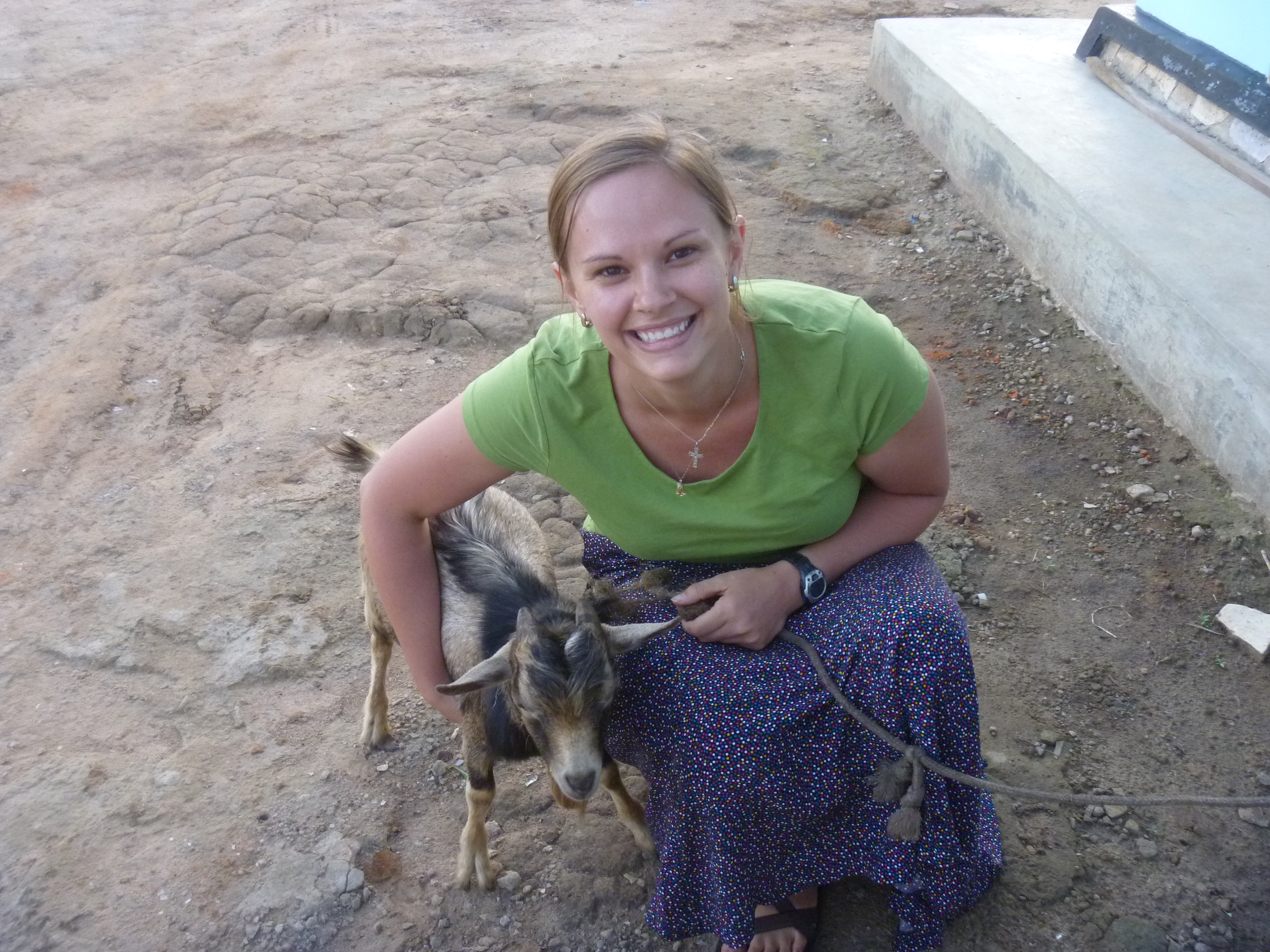
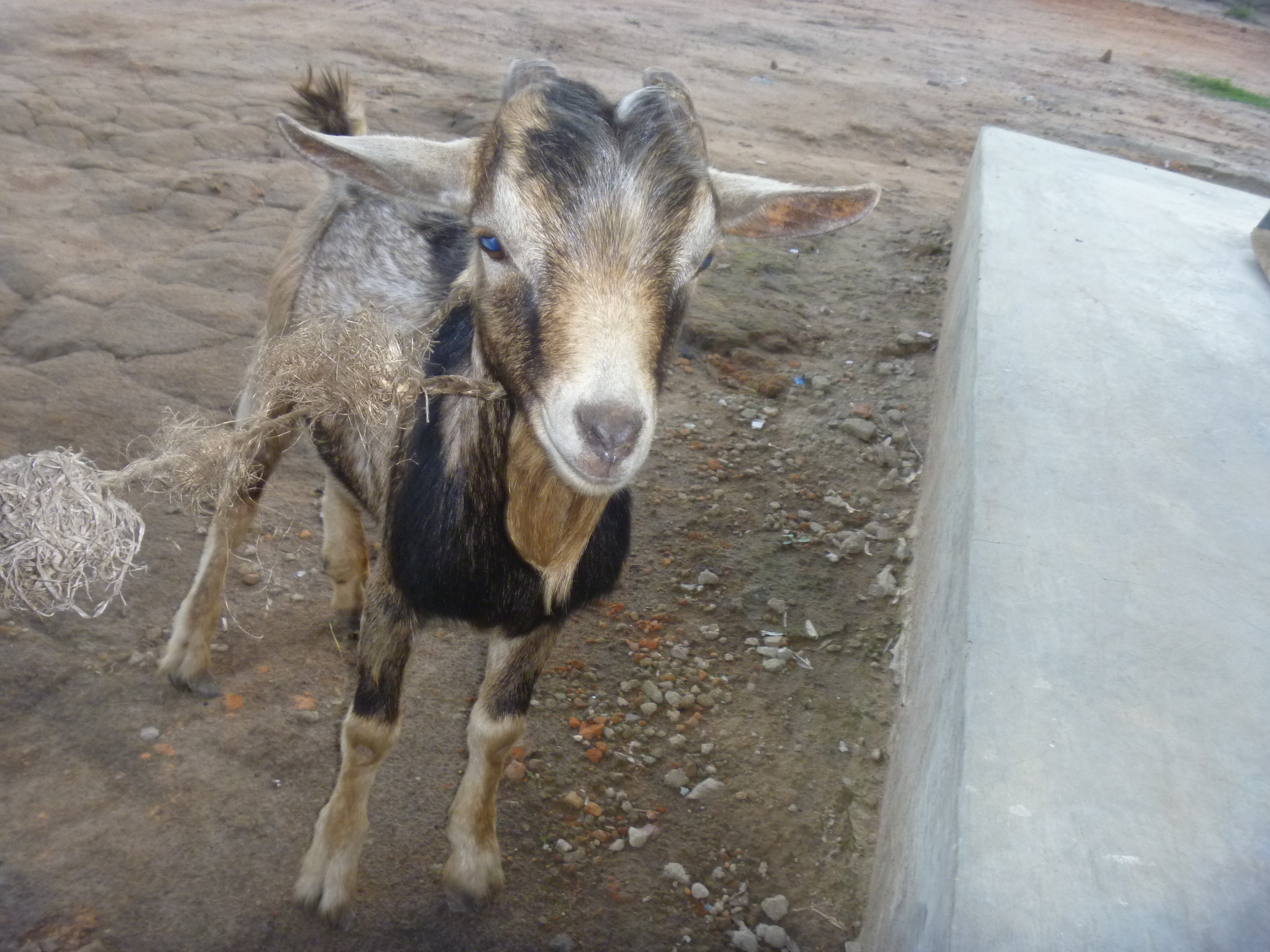
The youth cleared the aisle and a gentleman who was holding a rope appeared. He yanked on the rope and a goat reluctantly came forward!  As he handed the rope to Peter and me, I had lost all thoughts of keeping my facial expressions in check.  I hoped that the shock I was feeling was not written all over my face!  All I could think was “A goat! What in the world am I going to do with a goat?! Please, Lord, don’t let them ask me to eat it right now!”  What a gift!

I expressed my appreciation as best as I knew how.  I was glad that Peter was there to help me.  I have been here long enough to know that a goat is a very special gift.  A goat is much more expensive than a chicken and it could be used to feed many people.  In Sudan if a family has a successful harvest they will often use the profit to invest in a goat.  Steve has told me that one person could not possibly afford to give a goat- it takes many people combining their money to give such a gift! I am humbled by the generosity of these people and can see how much they appreciate the training and encouragement that has been given to them!

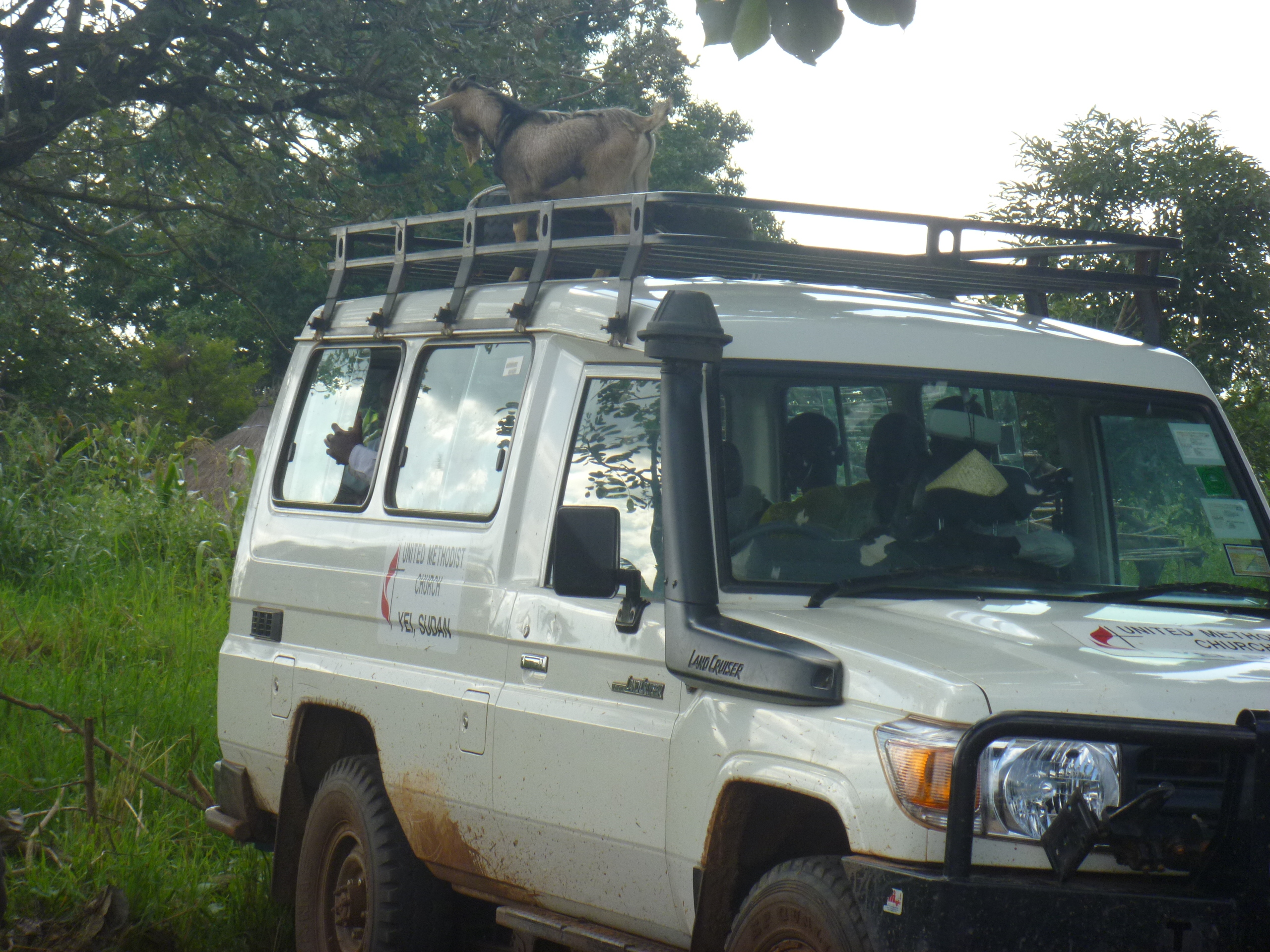
Though I am very appreciative, I cannot help but laugh at the fact that I am now the owner of a goat!  What in the world will I do with a goat!  The question of transportation was immediately in my mind.  We had come so far in a vehicle that was already packed full.  I couldn’t imagine how we were going to fit the goat in there with us for such a long drive.  Peter turned the goat over to Mark and asked him to take care of it.  To my surprise, when we headed out of the church to return home the goat was tied to the top of the LandCruiser!  I expressed my concern to Peter and Mark- how in the world would that goat ride on such a rough road without falling off!?  Mark assured me that he had tied him tightly.  ‘Great,’ I thought, ‘the goat will not only fall but would be strangled in the process!’  After seeing the look on my face, Peter put his hand on my shoulder and said “Don’t worry, Elizabeth, it is an African goat.  It knows how to ride this way!”

So here I am, now the proud owner of an African goat!

“A very fine goat, indeed!” Alex said as he pulled on the goat’s beard.  “He is old enough and will soon be ready to eat!”


Did I accidentally wear my Barney suit?

Because often times it feels like that here.  Although there are several “Kawaajas” (I just recently learned the proper spelling for the term that means “white person” in Juba Arabic) here, that in no way means that people don’t stop and stare.  I have taken several walks through small groups of tukles close to where I am staying. As I walk, I continually hear “kawaaja, how are you?” and many times “kwja, how wa wu?” which is the first English greeting Sudanese children learn.  There are times when I pass someone on the road and give a friendly nod and “hello” and in return I hear “I am fine.” This obviously goes right along with the first phrase.  It makes me smile every time.  I think how silly I must sound as I try to greet Neema in her mother tongue.  Because the people here almost always shake hands when greeting someone, it is no surprise that many of the children that I pass will stare at my hand until I extend it to them.  The other day Diantha and I were taking a path home that passed closely by a compound.  We were greeted with the high voices of children greeting us and then heard the stopping of their feet as they ran towards us.  It was late in the afternoon and they had obviously been playing outside- they were full of dust.  The youngest one who was maybe three years old made it to us first.  He didn’t have a shirt on and he looked like he could have been playing in a sandbox.  There he stood smiling at us, asking us how we were the best he knew how, with a freshly washed hand extended- it was still dripping!  The other children quickly followed behind him; their hands, too, washed in preparation for greeting us.  That image will remain in my mind for years to come.

Now that my luggage has arrived I have been jogging each morning.  I take a route that was suggested to me by the guards and is starting to be very familiar.  On the first day that I was out I passed a woman who is VERY pregnant.  I gave her a warm smile, pointed to her belly, and commented that the baby would be here soon.  She shyly smiled back at me, nodded in agreement, and went on her way.  The next morning we met in almost the same place and we exchanged warm smiles and a wave.  On the third morning running I again passed her, but this time I was greeted with a jubilant “Good morning, sister!”  It almost brought tears to my eyes.  I realized then how easily relationships can bud just by being present, by carrying on a normal routine.  God is so good!  I continued my run with a little extra spunk in my step and soon came up on a pair of little boys.  They looked to be about two years old and they were holding hands coming toward me on the path. The thought went through my mind that a picture of this scene could easily be sold on a greeting card.  Just then one of the boys caught sight of me and let out a blood curdling scream!  He was deathly afraid and began crying and ran the other direction! I must have forgotten to take off my Barney costume.  He called for his mother and found her pretty close by laughing at the scenario.  I had stopped in my tracks and turned away from him, feeling awful that my white skin had scared him so badly.  The mother continued to laugh and urged me to just continue on.  This, too, I shall not soon forget!

It has been quite an experience being around so many people with little exposure to Caucasians.  During the first week a few girls from the village were very curious about my hair and on of them worked it out so that she could sneak a touch to it.  Diantha had told me that this might happen, so I went ahead and let my hair down so that they could all touch it.  Just two days ago while I was eating lunch during a youth training I felt a breeze on my arm.  I looked over and found a girl of about 12 blowing on my arm to see the hair on it move!  She was embarrassed that I had caught her, but I do appreciate her curiosity.

If only they knew that I was just as curious about them. Not so much about the way their hair and skin feel, but about the way their relationships function.  I’m curious about their beliefs, traditions, and of course their language.  I’m glad to have so much time here to at least satisfy a small bit of my own curiosity!

Singing, dancing, walking, praising, studying, worshiping…

Hello Friends!

Wow have we been busy!  Today we held the first of our five follow-up cluster meetings. Four churches were invited and even though only three of them made it, the church was packed with more than 130 people!  Twenty five youth walked 17 miles yesterday evening so they could attend the training!  They will stay in Ridya again this evening and start their 4 hour journey early tomorrow before the sun is too high in the sky!  Talk about dedication!  Diantha and I rode in the 10 passenger Landcruizer to Yei Center church to pick up 4 of the youth leaders that we were expecting to go with us.  We pulled up to the church and out came TWELVE youth (there were already three of us in the car).  I first thought they had come to wish us a safe journey, but soon learned that was not the case.  They ALL piled into the back of the car!  Peter, the main youth leader instructed us that we would have a song and start with a prayer and then we could be on our way.  They immediately began singing, using any bit of exposed seat as a drum for a good beat.  When we finished we headed for Ridya.  We didn’t get very far before two more youth came running from the well.  The driver was told to stop and I couldn’t believe it when they too piled into the already packed cruizer.  Boy can those youth sing! And sing they did for the next hour and a half as we drove clear into the bush to Ridya church!

As always, I was completely moved by the singing and the worship.  Each church had prepared a presentation with singing and dancing to help kick off our training.  The leaders who had gone through the lessons last week were asked to lead the training today.  We got off to a bit of a rocky start and as in most teaching situations the next one is sure to go more smoothly.  Nevertheless, we were able to complete a little more than a full lesson and the leaders were given the materials to use to continue the study with the youth at their home church.  I think we are doing a great job empowering these young leaders and am glad that God is doing it through us!  Please keep praying for the youth at Ridya, Ligitolo, and Morre.  On Friday we will have our second follow up meeting- please continue to pray for safe travel for the youth and for a smoother running program.

As for me personally, I am doing quite well.  Yesterday, finally, I got my luggage! I have never been so happy to see deodorant and my own soap!  I felt like a queen finally wearing my own clothes.  I was especially happy to have my tennis shoes and put them on at first light this morning for a short run while it was still cool.  The people here are up at first light and do their hardest work before it starts to get hot.  Fred and Libby have started a breakfast bible study with 5 of the people who work for them.  The first few mornings around the breakfast table were very quiet, but now they are working to teach us both Juba Arabic and Kokwa, which are the local languages.  I have learned how to ask to pass everything on the breakfast table!  The guards are also working on teaching me how to tell them where I am going when I leave and each day it seems that they use a new greeting on me.  I am thoroughly enjoying getting to know these people and trying to understand their culture.  Please pray that I will continue to learn and build relationships with them.  Pray for my energy level as well.

Tomorrow I will visit Yei Teacher Training College and meet with one of the administrators.  She will take me on a tour of the facility and share with me how the program works.  In the afternoon I hope to sit down with a woman who does HIV/AIDS prevention training for both adults and youth.  Both of them are in the fellowship that meets on Sunday evenings and I am looking forward to learning more about the other organizations that are working in this area.

Again, I thank you for all of your prayers, emails, and messages.  It is so encouraging to know that I have so much support!

Love,
Elizabeth